

Some work only becomes visible when it stops
Most of what holds a life together was never meant to be seen.

There was always food on the table before I was hungry enough to ask for it.
I don’t remember thinking about that as a child. Hunger arrived, and so did the meal. In the logic of childhood, that was simply how things worked. You needed something, and it was already there.
It took me years of cooking for my own family to understand that “already there” is not a natural state.
It is someone’s morning.
But the moment that stays with me most is different.
When my brother and I argued, the way children argue, over something small that felt enormous at the time, my father rarely raised his voice. He didn’t step in to declare a winner or assign blame. He would wait for the right moment, and then ask a question.
One question. Not an accusation. Not a lecture hidden inside a sentence. Just something that made you stop, turn inward, and suddenly feel slightly ridiculous about whatever you had been defending so loudly a moment before.
I don’t remember most of those questions.
I remember what they did.
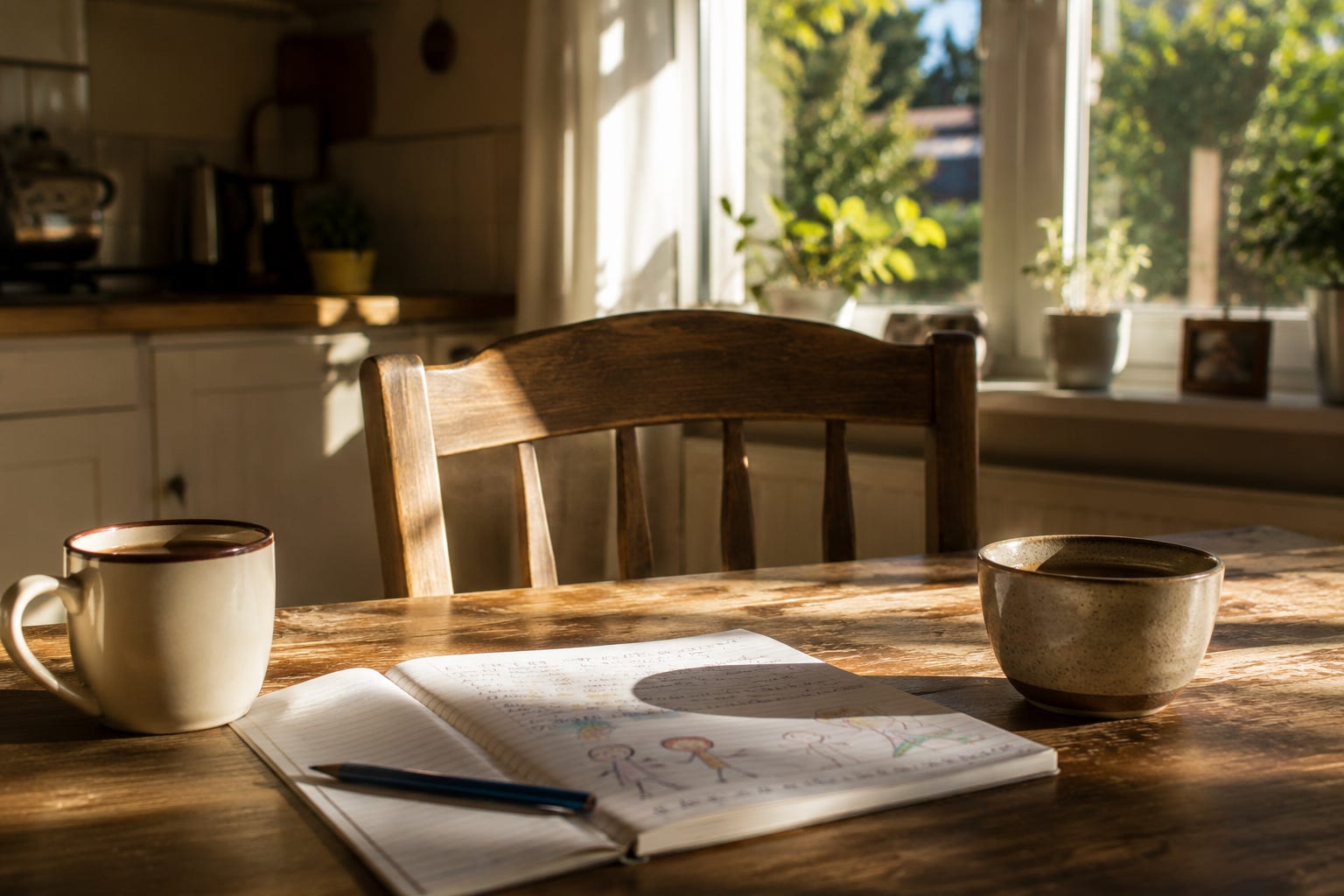
They moved the ground beneath the argument until the argument had nowhere left to stand.
And what I remember even more clearly is the feeling that followed, not shame, not defeat, but something closer to pride. The pride of being led somewhere better by someone you trusted completely. The particular satisfaction of a child who has been taken seriously enough to be asked a real question instead of simply told what to do.
I wanted to listen to him.
That was his authority. Not volume or force. Just the quiet certainty that he saw something you hadn’t seen yet, and was willing to wait while you found it.

I came home from school to a house that was already in order.
I never once wondered who ironed the shirt. I only remember opening the drawer and finding what I needed, exactly where it should be. Toys returned to where they belonged. Floors clean. Rooms quiet and arranged. The particular stillness of a space that someone has already moved through that morning, straightening what the day before had left crooked.
I walked into all of it and felt nothing remarkable.
That is the nature of invisible work done well. It doesn’t announce itself. It simply removes the friction from your day before you notice the friction was ever there.
And outside, in the garden, there was always something growing.
Vegetables. Fruit. The quiet labour of soil and season that required attention long before anything was ready to be harvested. We worked there together sometimes... small hands beside larger hands, not always understanding what we were doing, but present for it. The garden didn’t produce on its own. Someone planned it. Someone bent down in the early morning before the heat arrived. Someone knew which things needed water and which needed patience and which needed to be left alone for a while.
I ate the tomatoes without thinking about the months that preceded them.
Children are supposed to do that, I think. They are supposed to move through the world lightly, unburdened by the cost of things, free to play and argue and grow without the weight of what sustains them pressing down too early. That lightness is not selfishness. It is a gift that someone worked very hard to give.
But the gift has a shadow.
When work is done reliably enough, for long enough, it stops looking like work. It starts looking like the natural order of things. The meal appears. The shirt is clean. The garden produces. The house holds.
And because nothing breaks, nobody asks what is being held together.
Nobody asks because the whole point of the work is that nobody has to.
I don’t remember the exact moment it happened.
There was no single scene where everything became clear. It came in fragments, the way most important things do quietly, sideways, in the middle of something ordinary.
I was talking to my son.
I don’t remember what we disagreed about. Something small, probably. Something that felt enormous to him and slightly familiar to me. And somewhere in the middle of it, I heard myself looking for the right question. Not the winning argument. Not the point that would end the conversation in my favour. Just the question that would move the ground beneath him gently enough that he could find his own footing.
I recognized the instinct before I recognized where it came from.
And then I did.
I stood there for a moment, still in the middle of the conversation, and felt the strange doubling of it being the father and seeing the father at the same time. The words in my mouth had a shape I had received long before I knew I was receiving it. The patience I was reaching for had been given to me, quietly, over years, through a hundred moments I had not thought to name.
I was not inventing a way to talk to my child.
I was remembering one.
There are other moments like that.
Standing in the kitchen, watching a meal come together, understanding for the first time what it costs to have something ready before anyone is hungry enough to ask. Clearing the table after dinner without deciding to. Folding laundry that isn’t mine. Mowing the grass on a day when I had other plans, because it needed doing and I was the one who could. Staying calm in a room that wanted to become loud.
Each time, the same quiet recognition. A gesture I had received so many times as a child that it had become invisible to me and now it was in my hands, and I understood it differently.
My parents used to say, sometimes you’ll remember this one day.
It didn’t sound like a warning. It sounded like someone handing you something you couldn’t carry yet, trusting you would grow into it.
I think I’m still growing into it.
The work was always there. I just wasn’t old enough to see it.
And now that I can, I find myself doing it but not because someone asked, not because I decided to become a certain kind of person, but because somewhere along the way, without a single explicit lesson, I learned what staying looks like.
You fix what is broken before the child notices.
You ask the question instead of raising your voice.
You bend down in the garden in the early morning.
You stand up from the table.
You carry the thing privately so the room can stay calm.
And you hope, somewhere in the repetition of all these ordinary acts, that something is being passed forward.
Not as instruction.
As example.
Some work only becomes visible when it stops... in the small gaps that appear when the person who was quietly filling them is no longer there.
The meal that doesn’t quite come together the same way. The house that takes more effort to hold. The argument that goes slightly further than it needed to because nobody asked the right question at the right moment. The garden that still grows, but differently.
You don’t notice the architecture of a life until you’re the one responsible for holding it up.
My father made it look easy.
My mother made it look like the natural order of things.
Neither of them, as far as I can remember, ever asked to be recognized for it.
That may be the most difficult part to inherit. Not the work itself. The willingness to do it without keeping score.
I’m not sure I’ve managed that yet.
But I’m learning what it costs.
And some days, when I stand up from the table before anyone asks, or find the right question at the right moment, or simply stay when staying is the harder choice, I feel something that is not quite pride and not quite grief. The particular feeling of finally understanding a language you have been hearing your whole life.
As a child, I thought life simply worked that way.
Food appeared.
Problems softened.
The house held.
Now I know better.
Life didn’t work that way.
Someone did.
If any part of this felt familiar — stay. I’m glad you’re here.
And if you know someone whose work nobody sees — this might be the thing to send them.
I write for people whose work nobody sees — until it matters.
Double ID
Hi David, great post about invisible labor. its like that old phrase "you don't miss something until its gone". People we love serve us in so many ways-sometimes we don't even realize how much they are doing for us.