

The things fathers don't explain
A father's silence does not always end when he stops speaking. Sometimes it begins there.

I don’t remember noticing my father’s silence when I was young.
You don’t, when you’re a child. The world inside childhood is loud in its own way, full of small urgencies, invented games, the sound of other kids calling your name from the street below the window. A quiet father is just part of the furniture of the house. Solid. Present. Somewhere in the background, always doing something with his hands, always slightly apart from whatever noise the rest of us were making.
He was always doing something with his hands.
A broken toy would appear on the kitchen table one morning, a wheel fallen off, a small mechanism that had given up, a hinge that no longer held what it was supposed to hold. By evening it would be back in one piece. Sometimes better than before. Sometimes slightly different, improvised, adjusted, rebuilt from whatever was available in the drawer where he kept small things that might one day become useful. He never announced the repair. He never placed the toy back with ceremony or waited to be thanked. He simply fixed it and left it where it could be found again, waiting quietly for the child who had already forgotten it was broken.
I picked it up and went back to playing.
That’s what children do with invisible work. They receive it as ordinary. The price of things only becomes real once you’ve started paying it yourself.
He was available in a way that rarely asked for anything in return.
There were evenings when we sat together over a poem I had to learn by heart for school. He would read it with me. Once. Twice. Ten times if that’s what it took. Patient in a way that never felt like patience. It felt like he simply had nowhere else to be. And when I was tired of it, when the words stopped making sense from repetition, he would close the book and recite the whole poem back to me from memory. Without looking. Without hesitation. As if to say: it can be done. As if to say: I am still here.
I don’t know how he found that kind of stillness.
I only know I have spent years looking for it in myself.
After lunch, without announcement, he would sometimes stand up and start clearing the dishes before anyone else had thought to move. Not because someone asked. Not to demonstrate something. Just because the table needed clearing, my mother had already carried enough that day, and he was already standing. It was a small thing. The kind of small thing that happens so consistently it stops looking like a choice and starts looking like weather, something you notice only when it’s absent.
We called all of it normal.
That may be the quiet cost of invisible work. Not that nobody cares. But that everyone slowly forgets there is someone to notice.
Like a foundation you walk on every day without once thinking about what it’s holding up.
Then there was the painting.
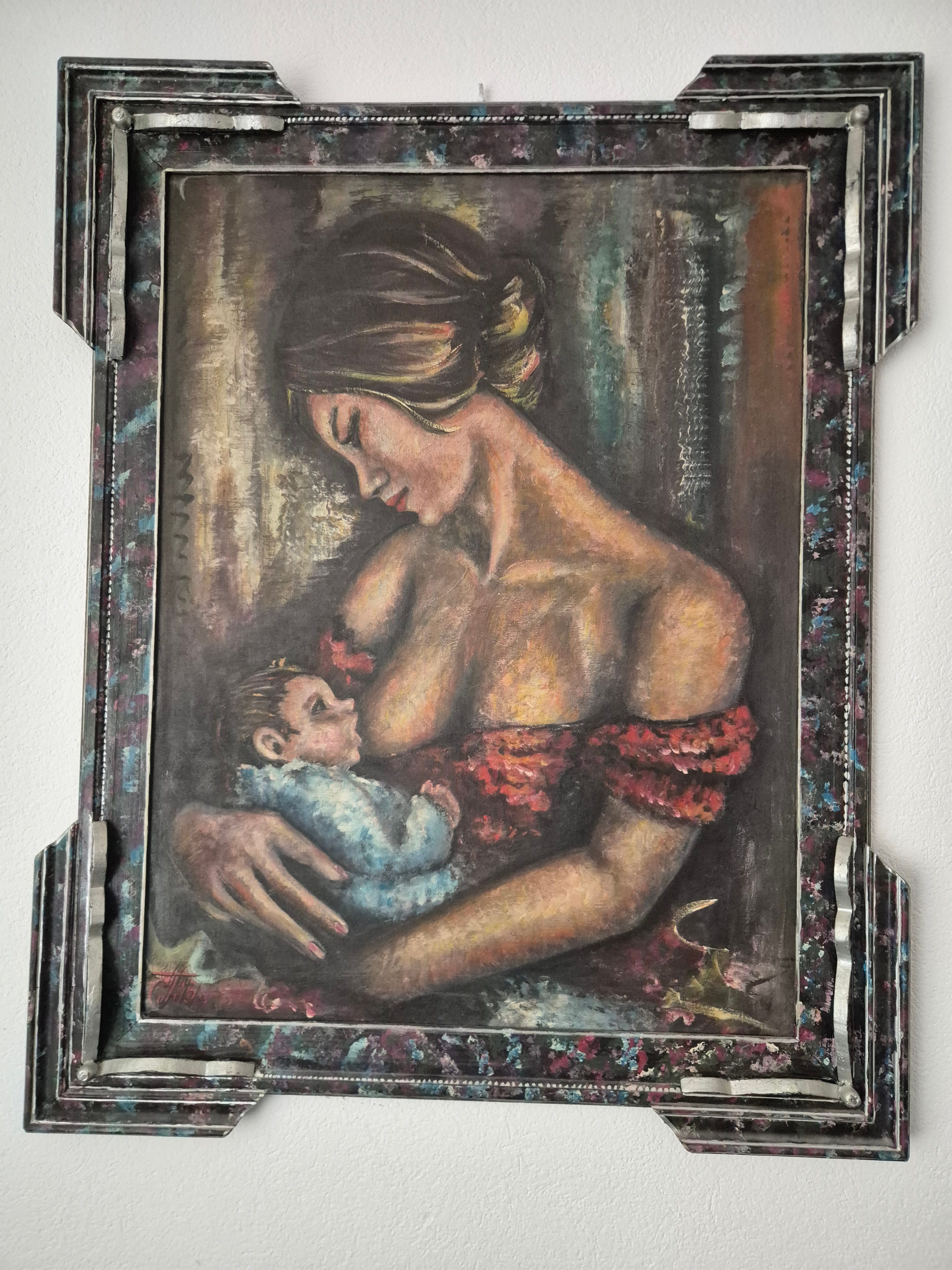
one of his paintings hanging in my living room, something you won’t see anywhere else
On weekends, when the rest of us scattered to the playground, to friends, to the pleasant chaos of a day without school, he would often stay. Set up at a table covered in colour, brushes arranged beside him with the quiet order of someone who takes their tools seriously. Tempera on canvas. Oil on canvas. Sometimes a landscape, sometimes something else, always with that particular silence that has attention inside it, not the silence of absence, but the silence of a man entirely present in what his hands are doing.
Those paintings were good. People said so. Some were sold. There were special orders from people who had seen one on a wall somewhere and wanted something similar for their own. It was easy to call it a hobby. Easy to admire the finished image, the colours, the patience, the skill that made something beautiful appear from nothing.
What was harder to see was everything the painting also carried.
Because a father’s creativity does not always belong only to himself. Sometimes even the thing he loves most quietly becomes another form of responsibility. The hours at that table were real hours that could have been spent elsewhere, hours that cost something. And the fact that beauty sometimes also helped the house, that a finished canvas could become a small financial contribution to a family that needed contributions from every direction, that was never spoken aloud. It was simply understood. Silently folded into the gesture of a man sitting down with his brushes on a Saturday afternoon, doing something that looked like pleasure and contained, underneath, something much more complicated.
I didn’t understand that then.
I saw the painting. I saw the finished canvas. I saw someone carry it away carefully after paying for it. I heard the compliments. I may have felt something like pride in the vague, unexamined way children feel pride in parents as a reflection rather than a recognition.
I did not yet have the life required to understand the other side.
Now I do.
I understand it in the mornings when I wake before everyone else and sit in the kitchen while the house is still dark, with a coffee and twenty minutes that belong entirely to me before the day begins dividing itself among other people’s needs. I understand it in the small adjustments I make without naming them, the plan quietly changed, the desire postponed to a more convenient moment that rarely arrives, the thing I carry privately so the room around me can remain calm and the people I love can move through their day without knowing what almost broke.
I understand it in the way I sometimes stand up from the table and begin clearing dishes before anyone else has thought to move.
Not because it is noble. Not because I want to be seen doing it.
Because something in me learned, without a single explicit lesson, that this is what staying looks like. That love, for some people, never learned to speak in declarations. It learned to speak in repaired things, cleared tables, Saturday paintings, and the daily choice to make yourself useful to people who may not realize, for many years, that usefulness was also a kind of tenderness.
I don’t think I fully understand my father even now.
What stays with me is not an answer but an image of a man closing a book of poems and reciting them back to his child from memory. Not to impress. Not to end the evening faster. Just to show that the words were worth the effort. That some things deserve to be carried inside you, not just read from a page.
I’m still learning what he was trying to say.
As a child, I thought silence was simply silence.
Now I hear inside it everything that had no language.
The worry dressed as practicality. The care expressed as usefulness. The love that never learned to announce itself and so became, instead, a set of quiet acts repeated until they looked like the way life simply was.
A father’s silence does not always end when he stops speaking.
Sometimes, years later, it begins in the son.
Not as an answer.
As recognition.
If any part of this felt familiar… just stay. I’m glad you’re here.
And if you know someone whose work nobody sees… this might be the thing to send them.
I write for people whose work nobody sees… until it matters.
Double ID